
Letter 4 - Dalet Lesson
Shalom I am Rabbi Jim “Yaakov” Becka with Free Hebrew Class and this is Intro to Hebrew Reading & Writing for the Letter Dalet
Make sure to download the digital document to follow along and study at your own pace.
Welcome back to Hebrew Alphabet in 30 Days. Today we continue our journey through the Hebrew Alephbet with Letter 4 — Dalet. Dalet teaches us the “D” sound, how vowels change the meaning of a word, and how the Sheva vowel behaves in different positions. Let’s get started.
The Dalet is the fourth letter of the Hebrew alphabet, and it makes the “D” sound, just like in day or dog. According to the PDF on page 17, Dalet replaces the numeral four in Torah chapter subheadings.
Dalet may appear with or without a dagesh (a dot), but unlike Bet, Gimel, or Tav in ancient Hebrew, the presence or absence of the dagesh does not change the sound of the Dalet. It is always a “D.”
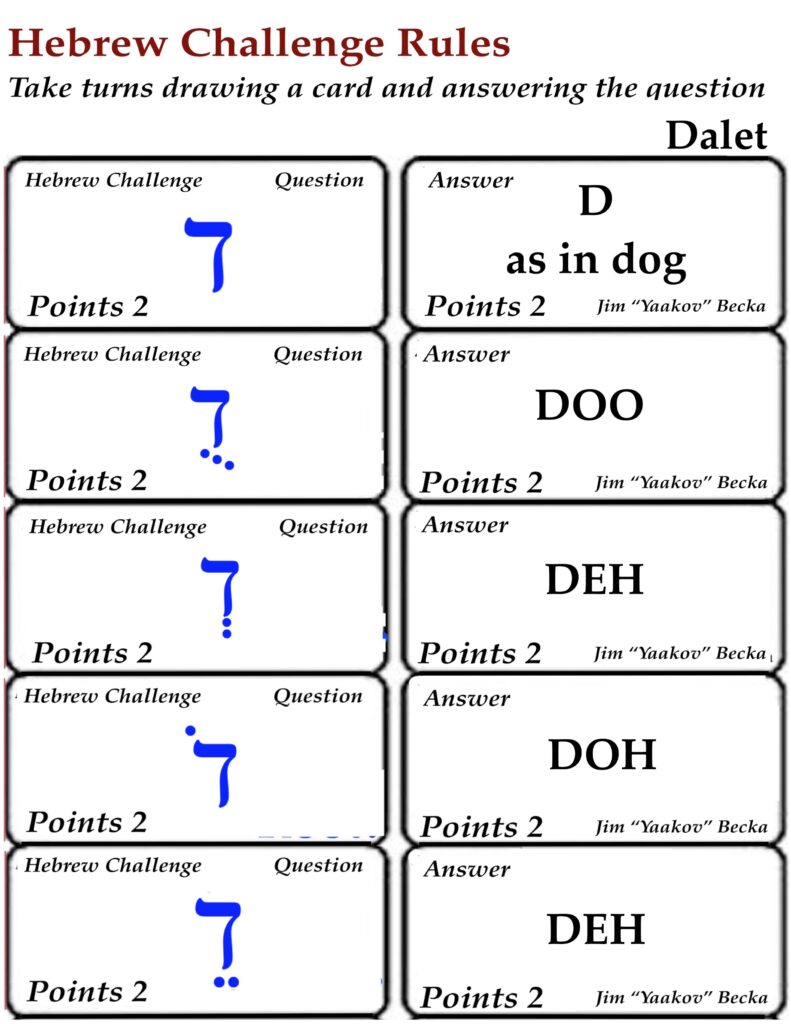
Lets Practice The Sounds
• EEV
• EHB
• EHV
• GEED
• AH-BAH
These words help strengthen your sound recognition. Cover the sounds with your hand and recite them from memory. This reinforces the rule: sound the consonant first, then the vowel.
Now let’s look at how vowels transform a word. On page 18, you’ll see the word related to “honey” and how each vowel change produces a new pronunciation.
• With a Sheva, Dalet is lightly vocalized: “DEH”.
• Adding a dagesh to the next letter turns it into Bet, so the word becomes “BEH”.
• Changing the vowel under Bet to AH gives “BAH.”
• Removing the dagesh turns Bet into Vet, giving “VAH.”
Each shift—dagesh or vowel—changes the entire sound pattern of the word.
Let’s practice writing Dalet. On page 19, you’ll see the stroke guide:
• Step 1: Draw the top horizontal line.
• Step 2: Add the vertical line down on the right.
Repeat this several times until the shape becomes familiar. You can also practice writing ABBA, meaning “daddy,” using the same letter combinations you’ve learned so far.
Students match words like:
• dag (fish)
• av (father)
• abba (daddy)
• bah (come)
• beh (in)
This exercise helps train your eye to recognize how consonants and vowels combine to form meaning.
Page 21 highlights one of the most important vowel principles: the Sheva.
The Sheva:
• Makes a short “EH” sound at the start of a word
• Is silent at the end of a word
• Is also silent when closing a syllable
An example given is the phrase “cha-leh” meaning “to you,” where the Sheva softens the second syllable.
Now we apply everything: consonants, vowels, Sheva usage, and letter identification. This builds fluency in recognizing Hebrew words quickly.
Great job completing Letter 4 — Dalet. You now understand its “D” sound, how vowel shifts create new meanings, how the Sheva functions, and how to read several Hebrew words with confidence.
Again I am Rabbi Jim “Yaakov” Becka with Free Hebrew Class and this is Intro to Hebrew Reading & Writing
May God Bless You